
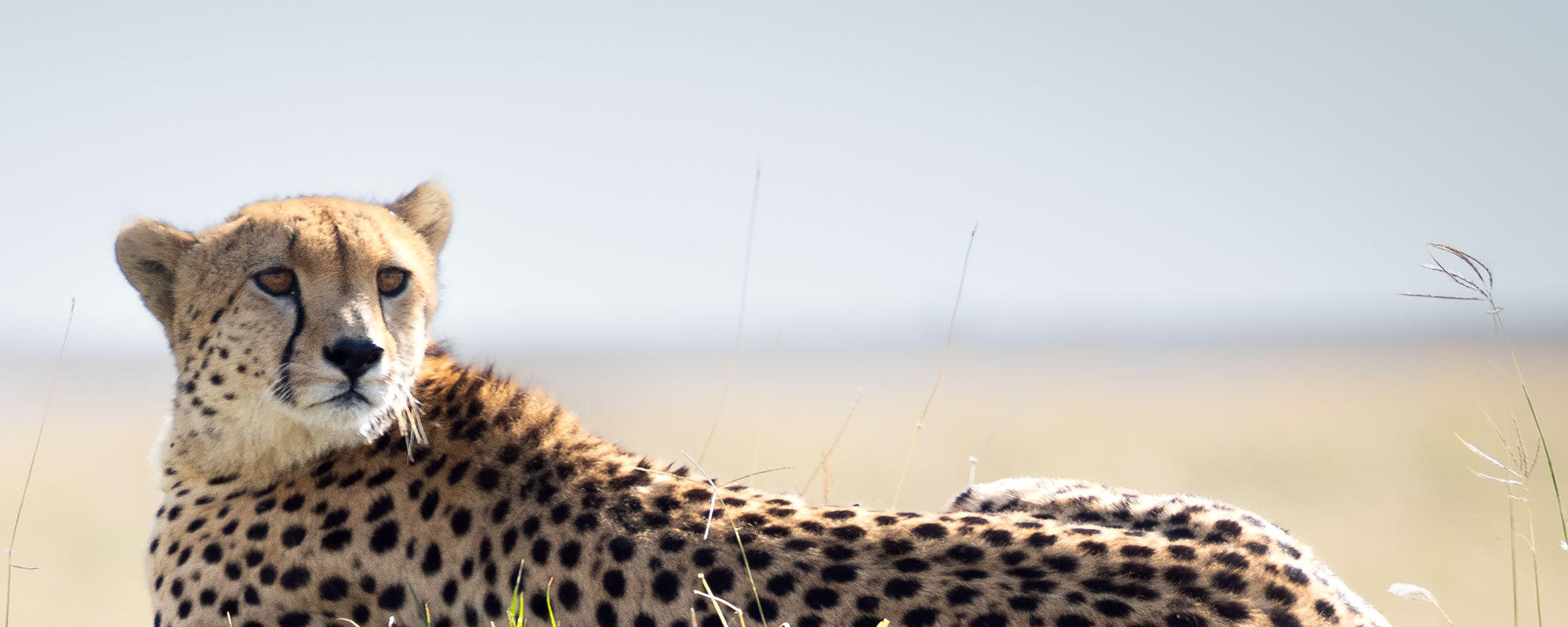
One of the most thrilling moments of the safari was witnessing the cheetah Ruka in pursuit of an impala. What began as a distant sighting quickly unfolded into an extraordinary display of speed, agility and precision. From a standing start, he launched after a nearby impala, accelerating with breathtaking speed across the grasslands. The entire chase lasted only 11 seconds, but it was enough. In a display of power, agility and precision that only a cheetah can deliver, Ruka successfully brought down his prey.

We first caught sight of Ruka walking across the plains, then sitting on a mound to view his surroundings. Our brilliant guide, Mike Masai, knew that he was hungry and on a mission for food so he positioned us on the other side of Ruka’s nearest prey, a herd of Impala.
The Impala were on full alert with the male Impala at the head of the herd. If you look closely, you can see Ruka approaching the herd very stealthily.

In the images below, Ruka is concealed in the long grass, patiently watching a small group of impala grazing on the open plains. His spotted coat blends perfectly with the dappled light and shadows of the savannah, making him almost invisible even from a relatively short distance.
At this stage, the impala appear completely unaware of the danger lurking nearby. They continue to graze, occasionally lifting their heads to scan their surroundings before returning to feed. Despite their keen eyesight and constant vigilance, they have not yet detected the stealthy predator hidden amongst the grass.
For a cheetah, the stalk is every bit as important as the chase itself. Unlike lions, which often hunt cooperatively, a cheetah relies on getting as close as possible before launching its attack. Every metre gained during the stalk improves the chances of success and reduces the amount of energy needed during the pursuit.
The impala’s greatest defence is its alertness, and the open grasslands of the Masai Mara usually provide an excellent opportunity to spot approaching predators. On this occasion, however, Ruka had chosen his position well. Remaining low and using the long grass as cover, he was able to edge closer without attracting attention.


After this, everything happened SO FAST.
These images capture the intended target, still unaware that it has been singled out. Within moments, the calm scene would erupt into action as Ruka exploded from his hiding place in a breathtaking burst of speed. What followed was an astonishing 11-second chase that demonstrated why the cheetah remains the fastest land animal on Earth.
(11 seconds as estimated by Ann Aveyard , our safari organiser and a brilliant photographer who managed to capture some AMAZING images of Ruka’s chase .)
MY images, all a bit of a blur , FAR too fast for me to capture the chase
so I would describe these images as something more ‘artistic’ such as ICM perhaps.


This photograph was taken shortly afterwards. The intensity of the hunt is over, replaced by a moment of calm. Ruka lies beside the impala, catching his breath after the immense physical effort required for the chase. His eyes remain alert, scanning the surrounding grasslands while he recovers.
For a cheetah, the hunt does not end with the capture. The burst of speed needed to catch prey leaves them exhausted and vulnerable. Competitors such as lions, hyenas and even vultures are quick to take advantage of any opportunity, so every successful hunt is a race against time.
Watching this sequence unfold was one of the highlights of my time in the Masai Mara. To witness the stalk, the chase, the capture and then this quiet moment afterwards offered a rare insight into the daily struggle for survival on the African plains.
These images are a reminder that behind every successful hunt lies an extraordinary combination of skill, speed and endurance, honed over thousands of generations. For Ruka, 11 seconds of effort had secured another day of survival.


In the Masai Mara, a successful hunt is only part of the story. News of a kill travels quickly across the savannah.
Before long, the first vultures began to appear, circling high overhead on rising thermals. With astonishing eyesight, they had spotted the opportunity from miles away. One by one they descended, their numbers steadily increasing until a gathering crowd surrounded the carcass. Patient but persistent, they waited for their chance.
Soon they were joined by a Marabou Stork, an imposing figure standing head and shoulders above the vultures. With its bald head, powerful bill and almost prehistoric appearance, the stork seemed perfectly adapted to its role as one of Africa’s most efficient scavengers.

Gallery of scavengers
Ruka’s successful hunt attracted attention almost immediately. While he rested beside the impala, the first vultures began to appear, gliding silently down from the sky. What started as a handful of birds soon became a gathering crowd as more and more vultures arrived, each hoping for a share of the meal.
At first they kept a respectful distance, wary of the cheetah’s presence. But as Ruka’s appetite was satisfied and he moved away from the carcass, their confidence grew. Wings spread wide, they landed heavily in the grass before advancing towards the remains. Within minutes, the carcass was surrounded by a jostling mass of vultures, each bird competing for position.
Soon a Marabou Stork joined the gathering. Towering above the vultures on its long legs, the stork cut an imposing figure. With its massive bill and almost prehistoric appearance, it seemed perfectly suited to this role. Unlike the frantic activity of the vultures, the Marabou waited patiently for its opportunity before stepping forward to feed.


The transformation was remarkable! Only a short time earlier, the impala had been the focus of one of the most dramatic chases I had ever witnessed. Now the scene belonged to the scavengers. Vultures landed from every direction, wings beating as they fought for space, while the Marabou Stork stood watch over the proceedings.
It was a powerful reminder that in the Masai Mara nothing is wasted. The energy gained by the impala from grazing the plains would now pass to the cheetah, the vultures and the stork. Predator, scavenger and prey were all connected in a continuous cycle of life, death and renewal
After feeding well from the impala, Ruka might not need to hunt again for 2–3 days

BACK TO MASAI MARA SAFARI HOMEPAGE
Gallery of images in the correct sequence


